
High Availability and Load Balancing for Outbound Emails
When managing outbound email, high availability (HA) and load balancing are critical to ensuring emails are sent reliably, efficiently, and without interruption. This article explores the concepts, benefits, and implementation strategies for achieving both high availability and load balancing for SMTP (Simple Mail Transfer Protocol) servers.
High availability refers to the system's ability to remain operational in the event of a server failure, maintenance, or unexpected outages. Load balancing involves distributing emails across multiple servers/networks to avoid saturating a single channel during high loads.
Implementing High Availability (HA) and Load Balancing (LB) When Using Xeams
There are multiple ways to achieve these goals. The two most popular approaches are:
- Using DNS round-robin
- Using a hardware-based load balancer
Using a DNS server for HA and LB is the most economical and often the best solution. In this case, you assign a single name to multiple IP addresses. This is exactly how large organizations, such as Microsoft, Google, and Amazon, achieve HA and LB for their servers.
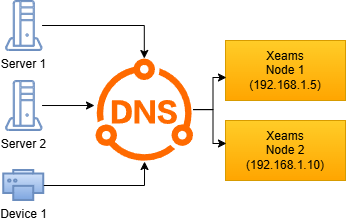
Every device and server must be configured to use a hostname, which resolves to at least two (or more) IP addresses. Since the DNS server resolves the hostname to multiple IP addresses, the device will pick one and try to send its message to that server.
Pros and Cons of Using DNS
Benefits
- Very easy to set up, since most organizations have a DNS server.
- Offers almost 50/50 load balancing
Shortfalls
- Less control over load distribution
Using a hardware-based load balancer gives you more flexibility. Organizations with high-traffic or mission-critical applications can greatly enhance their service availability and responsiveness by investing in these specialized solutions.
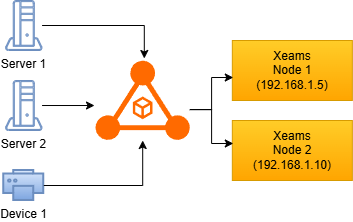
Since the load balancer will have its own IP address, every device and server must be configured to send its SMTP traffic to the load balancer, which will then forward the message to an appropriate downstream node.
Pros and Cons of Using a Load Balancer
Benefits
- More control over distribution. Many load balancers support different load-balancing algorithms, such as round-robin, sticky bit, or failover.
Shortfalls
- Extra expense and hardware to maintain.
Can I use Built-in Clustering in Xeams?
Xeams includes clustering, allowing you to configure it in a master/slave configuration. However, this clustering is intended for inbound spam filtering and enables filtering rules to synchronize across multiple nodes. There is no benefit in using this clustering when using Xeams only for outbound relaying. Therefore, using either the DNS or a hardware device to achive HA and LB when only using Xeams for outbound relaying is the recommended approach.